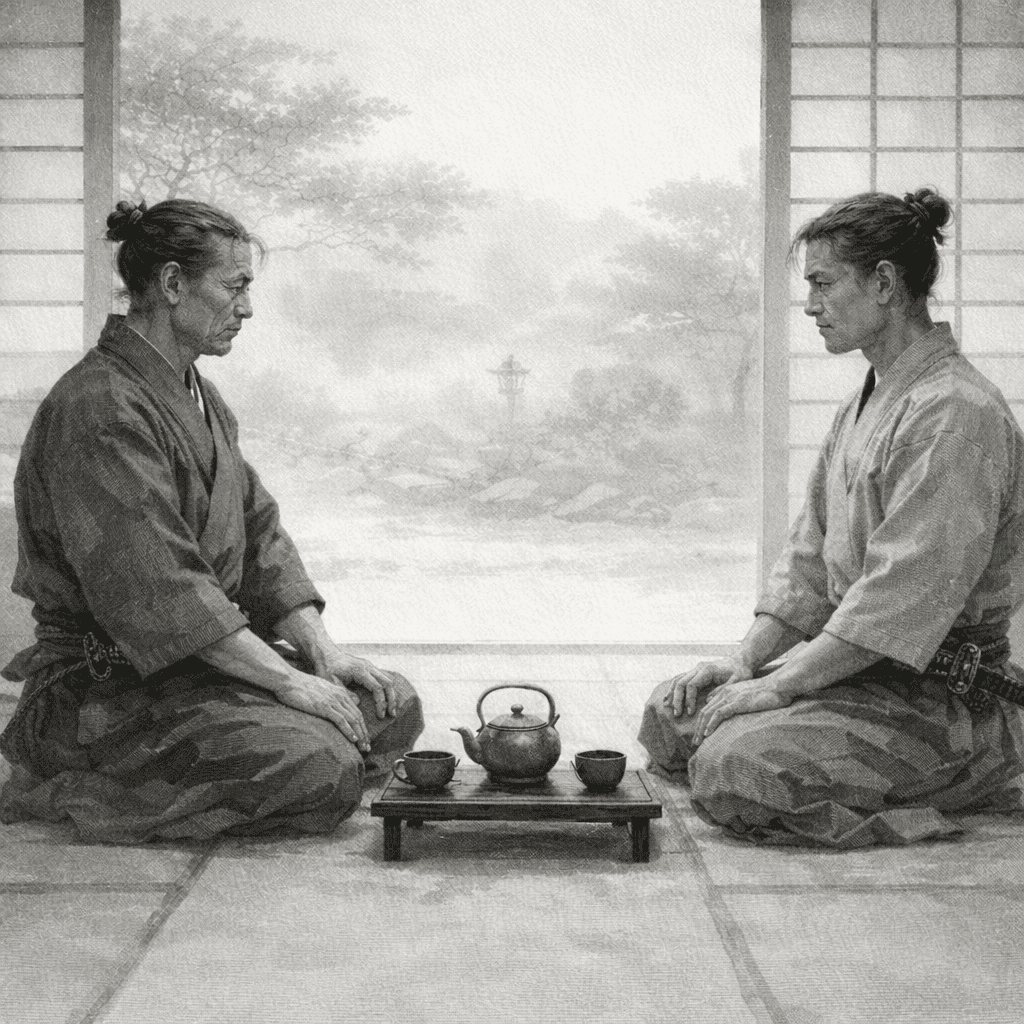
Lessons from Tsukahara Rengetsu (塚原 蓮月) – An imaginary samurai master
Lesson 3
A young swordsman came to Rengetsu in frustration.
“I train every day,” he said. “My strikes are faster. My body is stronger. Yet when I face an opponent, my movements become clumsy. My mind scatters.”
Rengetsu poured tea.
They sat in silence.
At last Rengetsu asked, “When you hold the sword, what fills your mind?”
The student answered immediately.
“I think about winning. About timing. About my stance. About avoiding mistakes. About what my opponent may do.”
Rengetsu nodded.
“You carry too many swords.”
The student looked confused.
Rengetsu lifted a wooden practice blade resting nearby.
“A sword is heavy,” he said. “Even one.”
He placed another stick into the student’s hands. And then another. He continued until the student struggled simply to hold them all.
“How will you strike now?”
“I cannot,” the student admitted.
Rengetsu removed the extra sticks until only one remained.
“How will you strike now?”
The student started to describe various techniques and approaches he could take.
Rengetsu shook his head. “You are still holding too many swords. Too many approaches. Too many ideas.”
As the student paused to think Rengetsu moved blindingly fast, removing the wooden sword from the student’s hand. In the blink of an eye he was holding it steadily at the student’s neck.
“In combat,” he said, “technique must already be finished.”
“The body moves. The mind watches.”
He gave the wooden sword back to the student.
“Training is not repetition in order to remember movements, but to forget thinking about them. When action requires thought, it is already late.”
“A warrior whose mind shouts instructions to his body moves in fragments.”
“A warrior who trusts preparation moves as one piece.”
Rengetsu drank his tea.
“Each day’s practice is invisible.”
“When performing any task, notice how often you interfere with yourself.”
“Notice the extra thoughts.”
“The corrections.”
“The doubts arriving after action has begun.”
“Do not fight them.”
“Simply return to the action itself.”
“One movement.”
“One breath.”
“One task.”
He set the empty cup down.
“When the mind stops reaching ahead or pulling behind, action becomes whole.”
Rengetsu looked toward the garden gate.
“This is the third gate of Budo.”