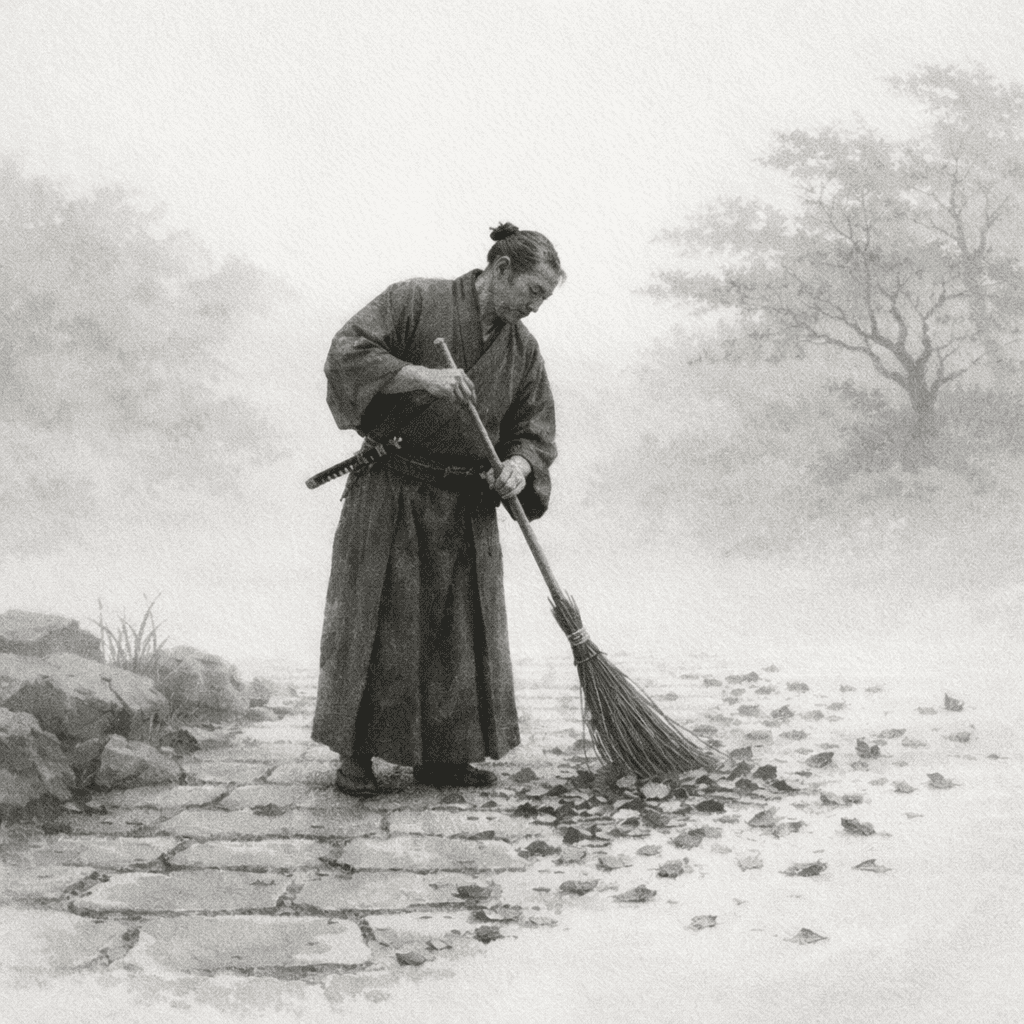
Lessons from Tsukahara Rengetsu (塚原 蓮月) – An imaginary samurai master
Lesson 2
A student asked Rengetsu,
“Master, how can I become strong?”
Rengetsu was sweeping an empty garden path.
The student waited for instruction about swords, endurance, or secret techniques. Instead, the master continued sweeping long after the question had faded into discomfort.
At last the student said, slightly irritated,
“You did not answer.”
Rengetsu rested the broom against his shoulder.
“Did you see the wind this morning?”
The student thought for a moment and replied: “There was no wind.”
Rengetsu smiled faintly.
“Exactly.”
He pointed to the stones of the path. It was still clear of leaves or debris.
“When the wind comes,” he said, “weak men resist it. They stiffen themselves and eventually break.”
“When the wind does not come, weak men sleep.”
The student frowned.
Rengetsu resumed sweeping.
“Strength is not proven during hardship. Anyone can struggle when forced.”
A single leaf fell. He lifted it off the ground and placed it aside.
“Strength is revealed in ordinary moments.”
The samurai tradition does not praise intensity. It praises constancy.
A warrior who trains only when inspired becomes unreliable.
A warrior who acts only when watched becomes hollow.
A warrior who waits for the right feeling never arrives.
Discipline means doing what must be done when nothing demands it.
No audience.
No urgency.
No reward.
Just practice.
After some time, Rengetsu spoke again without turning.
“Today’s practice is smaller than you wish.”
The student listened carefully.
“Choose one action you know improves your life. Something simple. Something unremarkable.”
“Do it today without emotion.”
“Do it tomorrow without discussion.”
“Do it the next day without negotiation.”
He placed the broom back into motion.
“When effort no longer depends on mood, the path has begun.”
The garden was already clean.
Yet Rengetsu continued sweeping.
“This,” he said quietly, “is the second gate of Budo.”